

Self-driving cars depend on satellite navigation to know where they are. The signals are weak and easy to fake, and this makes them a target. Attackers can send false signals to a car and change its sense of location. This is called GNSS spoofing. In 2026, researchers began using language models to defend against it, and the early results look strong.
The Growing Threat
GNSS is the general name for satellite systems such as GPS and Galileo. Civilian signals have no built-in protection, so a receiver often trusts whatever it hears. A spoofer can use this to send a vehicle down the wrong road or make it stop in the wrong place. The danger is not only theoretical. Ukraine, the Baltic countries and Poland already face heavy jamming and spoofing of satellite signals.
Checking the Story
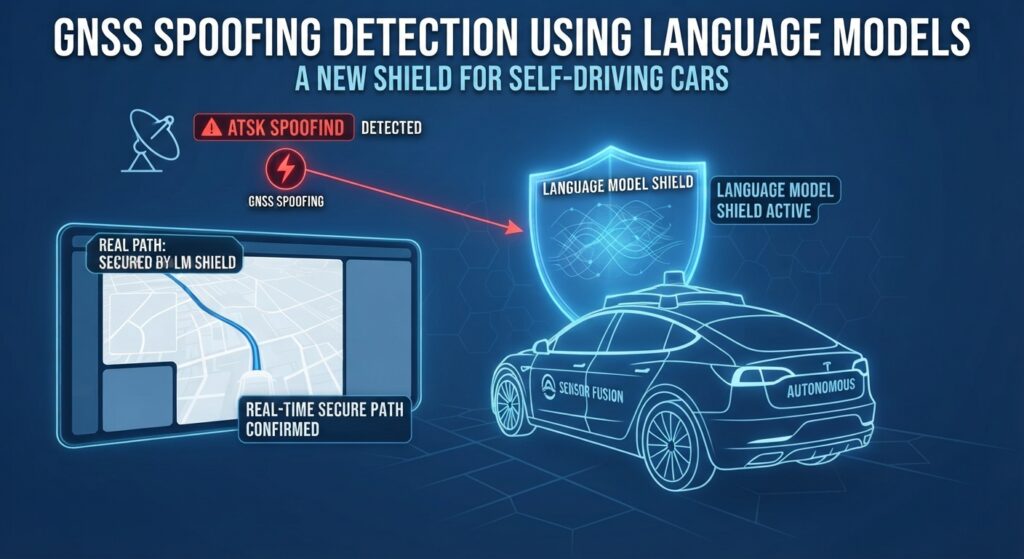
In July 2026, Aldeen et al. (2026) published a paper called “Development of Vision-Language Model-based GNSS Spoofing Detection for Autonomous Vehicle Navigation.” The authors describe it as the first framework of its kind to use a vision language model for GNSS spoofing detection in autonomous vehicles. The model looks at the front camera and reads data such as speed, acceleration and turning rate. It then compares what it sees with the moves that GNSS claims (Aldeen et al., 2026).
The results were strong. The system caught every wrong turn attack and every stop attack in the tests. For overshoot attacks, accuracy reached between 88 and 93 percent (Aldeen et al., 2026). The paper is still under peer review at NAVIGATION, the journal of the Institute of Navigation.
If you mention the small language model study, cite it like this: “Enan et al. (2026) found that small models reached about 97 percent average accuracy.”
Keeping It Fast and Affordable
Large AI models can be slow and expensive to run, which is a problem inside a moving car. The team solved this with a rule that decides when the model is really needed. The model runs only 14 percent of the time, which cuts the computing work by about 86 percent. Each four second window is handled in 65 to 73 milliseconds.
Small Models, Similar Results
A second paper, published in August 2026, took a different path. It turns driving data from GNSS and other sensors into short text descriptions and gives them to a small language model. The small models reached about 97 percent average accuracy, close to the results of larger models. They also used less memory and answered faster. Tests on data from a different location gave good results too.
What Still Needs Work
This field is young. Most studies focus on road vehicles, so aircraft, ships and timing systems need more research. Many of the papers are early preprints. These tools also spot strange behavior after an attack starts. They do not repair weak signals at the hardware level.
Thoughts
Language models will not replace strong satellite security. Still, they add a useful second layer. A car that checks its own story against its senses is much harder to fool, and that makes roads safer for everyone.
References
Aldeen, M., Irfan, M. S., Dasgupta, S., Cheng, L., Rahman, M., & Chowdhury, M. (2026). Development of vision-language model-based GNSS spoofing detection for autonomous vehicle navigation [Preprint]. arXiv. https://arxiv.org/abs/2607.23962
Enan, A., Dasgupta, S., Rahman, M., Chowdhury, M. (2026). Structured driving-state narratives for small language model-based GNSS spoofing detection [Preprint]. arXiv. https://arxiv.org/abs/2608.17092